Writing source and store plugins
The sources that collate reads from and the
data stores that accessions are deposited in are plugins, found by the
same mechanism:
each source plugin is a subpackage of the
accessionflow.sourcesnamespace package, e.g.accessionflow.sources.orthanceach store plugin is a subpackage of the
accessionflow.storesnamespace package, e.g.accessionflow.stores.xnat
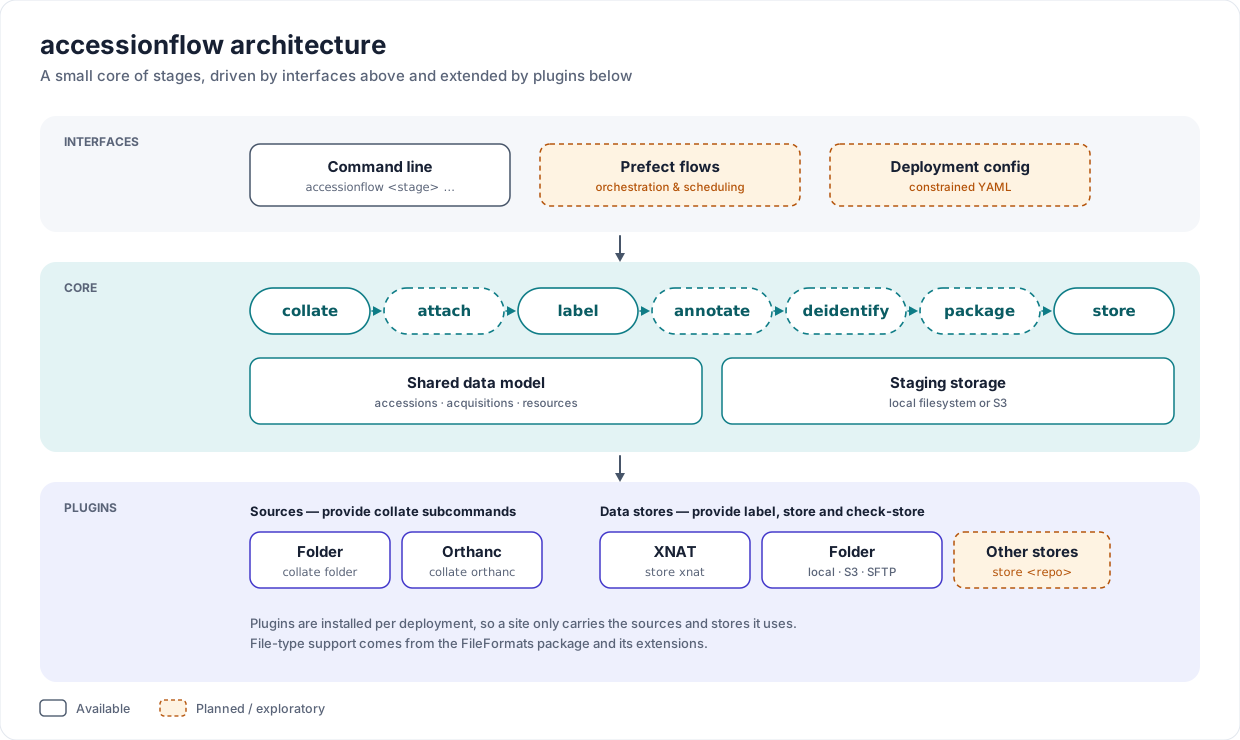
accessionflow, accessionflow.sources and accessionflow.stores are namespace
packages, so none of them may contain an __init__.py. That lets plugins be installed
from separate distributions, including editable installs, and still be found. A plugin
package accessionflow-mysource only needs to ship an
accessionflow/sources/mysource/ directory.
A plugin package defines its configuration in its __init__.py, and may have a
cli subpackage that registers its subcommands. The CLI imports the cli
subpackage of each installed plugin the first time it looks up one of a stage's
subcommands. A plugin that fails to import is skipped with a warning, so that one broken
plugin doesn't stop the others' commands from running. The folder source and store,
included with AccessionFlow, are short worked examples of each kind.
Source plugins
A source plugin
defines
SOURCE, anaccessionflow.model.source.Sourcenaming the source, e.g.Source(name="mysource", title="My source"). The name is the subcommand's,collate mysourceregisters
collate <name>with@accessionflow.cli.collate_group.command(...), decorated with@accessionflow.cli.collate_optionsfor the options every source shares (--loop,--wait-period,--copy-mode,--convert,--logger,--additional-loggerand--raise-errors)saves the accessions it collates into the staging directory in the layout the later stages read (see Staging directories), e.g. by building
Accessionobjects that reference the files at the source and passing them toaccessionflow.api.save_accessions_to_dir(), which builds each one under__build__and moves it into place once it is complete
For example:
# accessionflow/sources/mysource/__init__.py
from accessionflow.model.source import Source

SOURCE = Source(name="mysource", title="My source")
# accessionflow/sources/mysource/cli/__init__.py
from pathlib import Path

import click

from accessionflow.cli import collate_group, collate_options

from ..api import collate


@collate_group.command(name="mysource", help="Collates files from my source")
@click.argument("output_dir", type=click.Path(path_type=Path))
@collate_options
def collate_cmd(output_dir: Path, loop: int, **kwargs) -> None:
    ...
Store plugins
A store plugin
defines
STORE, anaccessionflow.model.store.Storethat names the store's label levels (e.g. XNAT's project, subject and session) and their default metadata fields, or leaves them to be named when labelling (labels=None, as the folder store does), and what the store calls an acquisition (e.g. XNAT's scan)registers
label <name>by callingaccessionflow.cli.make_label_command(STORE), which builds the subcommand from the store's label levelsregisters
store <name>andcheck-store <name>with@accessionflow.cli.store_group.command(name=...)and@accessionflow.cli.check_store_group.command(name=...)
store should refuse an accession that was labelled for a different kind of store,
which is recorded in its store_type (see Labels and data stores).
Checking a plugin is found
accessionflow collate --help and accessionflow store --help list the installed
plugins' subcommands. Running a stage with a name that isn't installed says which
plugins are, e.g.:
$ accessionflow collate mysource ...
Error: Cannot run 'collate mysource': no source plugin named 'mysource' is installed.
Source plugins are subpackages of 'accessionflow.sources', e.g.
'accessionflow.sources.mysource' (sources available for 'collate': folder, orthanc)